
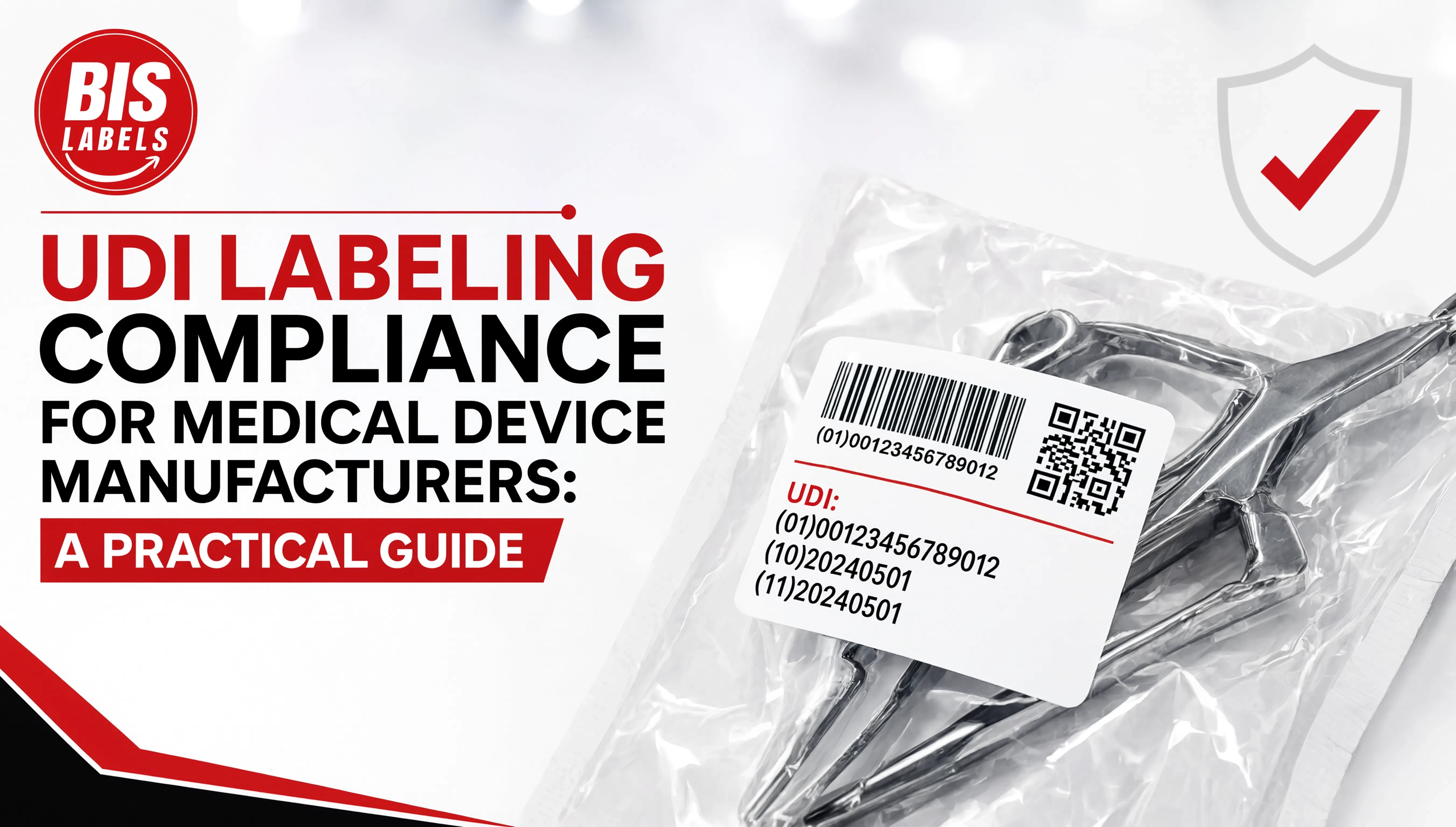
The FDA's Unique Device Identification (UDI) rule has been phasing in for over a decade, and by now most device manufacturers know the deadline pressure is real. What's less well understood, especially by teams outside the regulatory affairs function, is how much of UDI compliance actually comes down to physical label production: the barcode format, the substrate, the print method, and whether the label survives the device's full handling and sterilization cycle without degrading.
This guide breaks down what UDI actually requires in plain language, what that means for your production and print environment, and how label sourcing decisions fit into your broader quality management system (QMS).
What UDI Actually Is
A UDI is a unique code assigned to a medical device, required under FDA regulation (21 CFR Part 801, alongside the broader UDI system established in Part 830) so that every device can be identified consistently through manufacturing, distribution, and use. The system exists to make adverse event reporting, recalls, and device tracking faster and more reliable, instead of relying on inconsistent manufacturer-specific part numbers, every covered device carries a standardized identifier tied to the FDA's Global Unique Device Identification Database (GUDID).
A UDI has two parts:
Device Identifier (DI), a fixed, mandatory portion of the code that identifies the specific device model and the labeler (manufacturer). This part doesn't change between units of the same device model.
Production Identifier (PI), a variable portion that captures production-specific information: lot or batch number, serial number, manufacture date, and expiration date, depending on the device. This is the part that changes from unit to unit or batch to batch, and it's the part most likely to introduce errors if your print process isn't tightly controlled.
Both the DI and PI must appear on the device label in two forms: human-readable text and AIDC format (Automatic Identification and Data Capture, in practice, almost always a barcode, though some devices also use RFID). If your printed barcode and your human-readable text ever disagree, a transcription error, a print defect that alters a digit, that's a compliance failure even if the rest of the label is correct.
Where UDI Compliance Actually Breaks Down in Production
Most UDI compliance failures aren't caused by not understanding the regulation, they're caused by production and print processes that weren't built to support it reliably. Three areas account for the majority of real-world problems:
1. Variable data accuracy (the PI problem)
Because the Production Identifier changes with every lot or serial run, UDI labels almost always require variable data printing, pulling lot numbers, serial numbers, and dates directly from a production order or manufacturing execution system (MES) at print time, rather than manual entry. Manual re-keying of PI data is one of the most common sources of UDI errors, because a single mistyped digit creates a label that doesn't match GUDID and doesn't match the physical unit's actual production record. If your current label process involves anyone manually typing lot or serial numbers into label design software, that's a compliance risk worth addressing before it becomes a finding.
2. Barcode grade and print consistency
A UDI barcode isn't compliant just because it looks printed correctly, it needs to scan reliably, every time, throughout the device's shelf life and handling. This depends on print method and consistency as much as barcode design: a barcode printed inconsistently across a production run, or one that degrades after sterilization or cleaning-agent exposure, can pass a visual check today and fail a scan six months from now. This is where ribbon and substrate selection directly intersects with regulatory compliance, see Wax vs. Resin vs. Wax-Resin Ribbons Explained for how ribbon grade affects smudge and chemical resistance, both of which matter for a barcode that needs to stay scannable for the device's full service life.
3. Label durability through the device's actual use environment
UDI labels on devices that get sterilized, cleaned with solvents, handled repeatedly, or exposed to moisture need a substrate and print method built for that environment, not just for looking correct at the point of manufacture. A label that fades or smudges after a single autoclave cycle or alcohol wipe-down isn't just a cosmetic problem; it's a device that's out of compliance the moment its UDI becomes unreadable. This is why UDI labeling for durable or reusable devices typically calls for chemical- and heat-resistant synthetic label materials rather than standard paper stock.
How UDI Labeling Fits Into Your QMS
UDI compliance isn't a one-time label design task, it's an ongoing quality control point that should be built into your QMS the same way any other critical production step is:
- Controlled artwork tied directly to the device's GUDID record, so label content can't drift from what's registered with the FDA
- Validated variable data merge from your production order or MES, reducing the risk of manual transcription errors in the PI
- First-article and in-process barcode verification against recognized barcode quality grading standards, not just a visual pass/fail check
- Auditable batch records connecting each print run back to the specific lot, so a labeling question during an audit or recall has a clear paper trail
- Label sourcing and material selection documented and validated as part of your device master record, particularly for devices with sterilization or chemical-exposure requirements
Treating label sourcing as a QMS-relevant decision, not just a procurement line item, is generally what separates manufacturers who sail through labeling audits from those who end up scrambling to explain a barcode discrepancy after the fact.
A Related Compliance Category Worth Knowing
If your operation also produces labels for temperature-sensitive products, diagnostics, reagents, or anything with cold-chain handling requirements, the compliance logic follows a similar pattern to UDI: durability, data accuracy, and scan reliability all matter more than how the label looks on day one. We cover that adjacent category in Cold-Chain & Food Safety Labels.
Source UDI Labels Built for the Full Device Lifecycle
BIS Labels supplies specialty label materials suited to medical device production environments, including substrates built to hold up through sterilization, solvent exposure, and repeated handling without compromising barcode scannability. Browse our Specialty Labels line, or request a quote and tell us about your device's use environment and sterilization requirements; we'll help you match label material and print method to what your QMS actually needs to stay compliant.