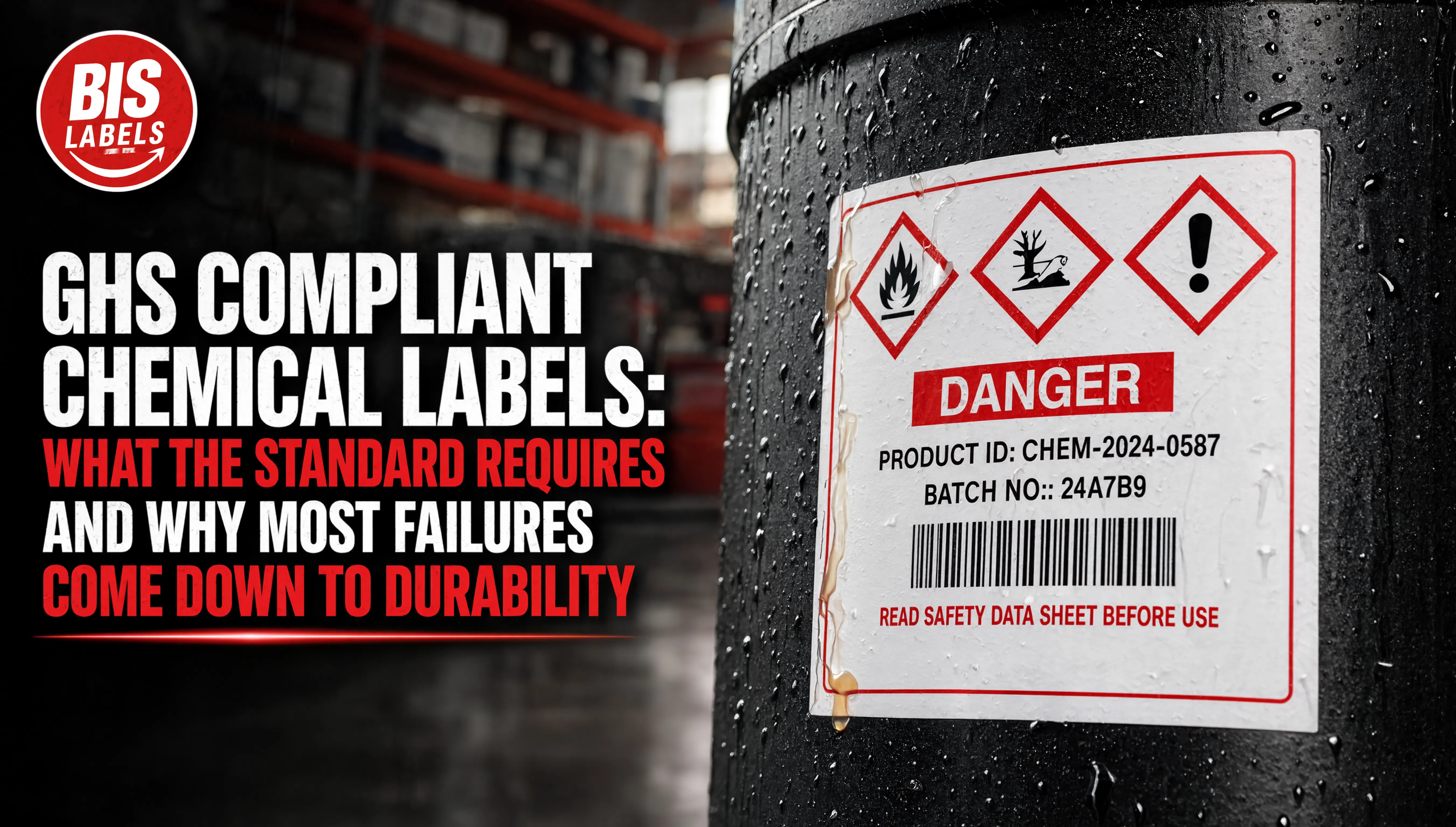
Every facility that manufactures, stores, or ships hazardous chemicals is required to label those containers under OSHA's Hazard Communication Standard, which aligns with the UN's Globally Harmonized System (GHS). Getting the label's content right, the correct pictogram, signal word, hazard statement, is the part most facilities focus on. It's rarely the part that actually causes a compliance problem.
The more common failure is physical: a GHS label that was correctly filled out on day one but peels, fades, or becomes unreadable weeks later on a drum sitting outdoors, in a chemical storage area, or on a container that's handled repeatedly. A label that's technically correct but no longer legible has failed its purpose just as completely as one that was filled out wrong to begin with. This is the same underlying substrate-and-adhesive survivability question covered in Chemical & Heat-Resistant Labels for Metal Stamping and Foundry Facilities, GHS labeling is simply the compliance-driven version of that same problem.
What a GHS Label Is Legally Required to Include
A primary GHS container label, the label on a container being shipped, stored, or used in the workplace, must include six standard elements:
- Product identifier, the chemical or mixture name matching its Safety Data Sheet
- Signal word, "Danger" or "Warning," reflecting the severity of the hazard
- Hazard pictogram(s), the red-bordered diamond symbols representing the specific hazard class
- Hazard statement, a standardized phrase describing the nature of the hazard
- Precautionary statement, handling, storage, and first-aid guidance
- Supplier identification, manufacturer or supplier name, address, and contact information
Secondary (workplace) labels, used for containers that stay in-house rather than shipping out, have a lighter requirement, generally just the product name and appropriate hazard warnings, but the durability expectation doesn't relax just because the label requirement is shorter. A secondary container in a chemical storage room is exposed to many of the same conditions as a primary shipping label.
Why Durability Is the Part That Actually Breaks
Chemical containers, drums, pails, IBCs, totes, go through conditions that degrade a standard label faster than almost any other industrial application:
Direct chemical contact. Spills, splashes, and surface residue from the product itself, plus solvents and cleaning agents used around the container, will dissolve the print or lift the adhesive on a label that isn't built to resist chemical contact.
UV and outdoor exposure. Drums stored outdoors or in uncovered yard areas take direct sunlight for months. UV exposure fades ink, embrittles standard face stocks, and degrades adhesive bond strength over time, a label that looked fine at fill time can be unreadable well before the container is emptied.
Moisture, humidity, and temperature swings. Chemical storage areas and outdoor drum yards see condensation, rain exposure, and repeated heating-and-cooling cycles, all of which stress adhesive bond the same way described for freezer environments, moisture is the common failure point whether the temperature swing runs hot or cold.
Curved, textured, and oily container surfaces. Metal and HDPE drums, IBCs, and poly totes rarely offer a smooth, clean, flat surface. Ribbed drum walls, textured plastic, and surface residue from filling all make it harder for a standard adhesive to bond and stay bonded.
Abrasion from handling. Drums get rolled, stacked, forklifted, and repositioned through their working life. A label without an abrasion-resistant print surface wears through its pictograms and hazard text well before the container reaches disposal or return.
BS 5609: The Certification Worth Knowing
For labels on chemical drums that may ship internationally or by sea, the relevant durability benchmark is BS 5609, a British Standard testing regime with two relevant sections: Section 2 tests the label material's durability, and Section 3 tests the adhesive's ability to remain bonded through prolonged exposure, including extended saltwater submersion. It's considered one of the most demanding durability tests applied to any label material, and while not every domestic GHS application legally requires it, BS 5609 certification is a useful proxy for "this label material was built to survive harsh chemical and outdoor conditions," even for facilities that never ship by sea.
Matching Substrate and Adhesive to the Application
Substrate. Standard paper labels are not a viable GHS substrate for any container facing chemical contact, moisture, or outdoor exposure, they fail nearly all four at once. A synthetic, chemical- and abrasion-resistant face stock, such as Polyester White Gloss, holds up to the same category of stress covered for metal stamping and foundry environments, and keeps barcode and pictogram contrast readable through the label's full working life rather than just at the point of application.
Adhesive. Drum and IBC surfaces are frequently curved, textured, or coated in residual product, conditions that lift a general-purpose adhesive within days. A high-tack, aggressive adhesive system built for difficult surfaces, like Hammerlock Adhesive, is designed to hold through exactly that combination of curvature, surface contamination, and outdoor exposure.
Print quality. GHS pictograms and hazard text are dense, small-format information, if the print itself smudges from a gloved hand or fades under UV, the label can be physically intact and still fail its compliance purpose. A smudge-resistant construction, like Smudge Proof, addresses that failure mode directly, the same way it does for oily handling environments elsewhere in industrial labeling.
A Practical GHS Label Checklist
Before finalizing a GHS labeling program, or auditing an existing one, it's worth confirming:
- All six required elements are present and accurate against the current Safety Data Sheet for primary shipping labels
- Substrate is rated for chemical, moisture, and UV exposure appropriate to how and where the container will actually be stored
- Adhesive is matched to the container material and surface condition, curved, textured, or oily surfaces need an aggressive adhesive system, not a general-purpose one
- BS 5609 certification is confirmed if any containers ship internationally or by sea
- Print method and material combination hold contrast and legibility through the container's full handling cycle, not just at initial application
- Labeling is consistent across primary shipping containers and secondary in-house containers, since both carry a legibility requirement even though their content requirements differ
Compliance That Holds Up Past the First Inspection
BIS Labels supplies chemical-resistant polyester face stock, high-tack adhesive systems, and smudge-resistant constructions built for the chemical exposure, UV, and handling that GHS-labeled containers actually face. Browse Polyester White Gloss, Hammerlock Adhesive, and Smudge Proof labels, or request a quote and describe your container types and storage conditions, indoor or outdoor, drum or IBC, domestic or international shipment, and our team will help you match a label material built to stay compliant for the container's full working life, not just at fill time.