If you've already settled on thermal transfer over direct thermal for a label that needs to survive longer than a few days, the next decision determines whether that label actually holds up in the field: which ribbon grade goes on the printer.
This is a separate question from label substrate. A thermal transfer label, paper, polyester, or polypropylene, is the surface the image lands on. The ribbon is what puts the image there, and it's the ribbon's formulation, not the label material alone, that determines how well the print resists smudging, scratching, heat, and chemical exposure. Get the ribbon wrong and you can end up with a barcode that looks fine on day one and fails a scanner three weeks later, or a print head that wears out well ahead of schedule because the ribbon's coating is too abrasive for the run.
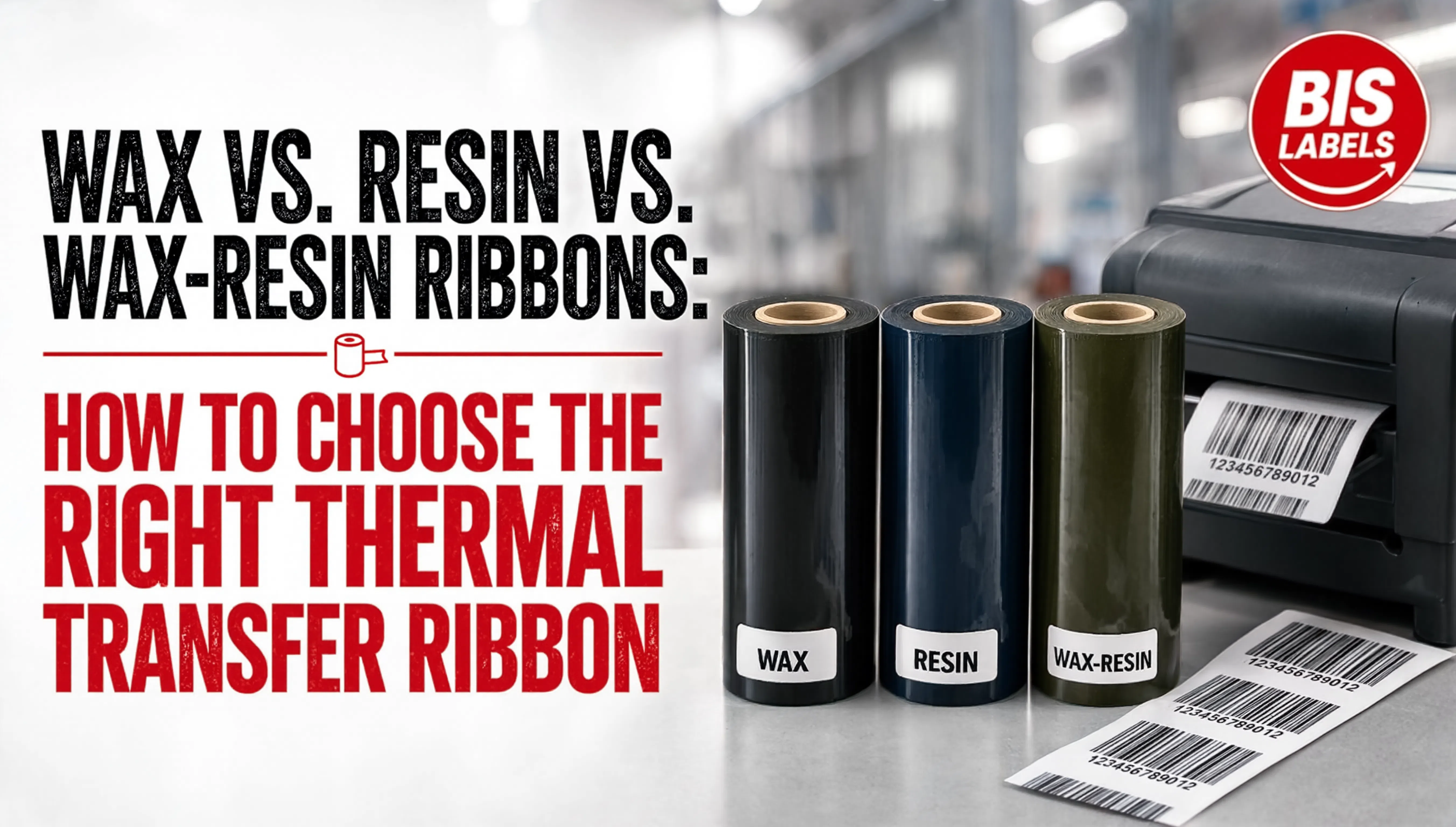
There are three ribbon families, wax, resin, and wax-resin, and each is built for a specific combination of label material, print speed, and environmental exposure.
How Thermal Transfer Ribbons Are Built
Every thermal transfer ribbon has the same basic construction: a thin polyester film backing coated on one side with an ink layer. The print head heats the ribbon from the backing side, melting or partially melting the coating so it transfers onto the label as the ribbon and label stock pass through together. What differs between wax, resin, and wax-resin ribbons is the composition of that coating, and that composition is what determines melting temperature, smudge resistance, scratch resistance, and chemical resistance.
As a rule, the more resin in the formulation, the more durable, and more expensive, the ribbon. Wax sits at one end of that spectrum, resin at the other, with wax-resin blends bridging the gap.
Wax Ribbons: Economical, General-Purpose Printing
Wax ribbons have the lowest melting point of the three families, which means they transfer at lower print head temperatures and run at higher print speeds with less wear on the print head. They're formulated primarily for use on uncoated and coated paper labels, the most common label substrate for retail tags, general shipping labels, and warehouse identification where the label isn't exposed to much beyond normal handling.
The tradeoff is durability. Wax print is soft and sits on the surface of the label, so it smudges under light abrasion, fingerprints, and moisture, and it has essentially no resistance to solvents or extended heat exposure. For a barcode that gets scanned once or twice indoors and doesn't need to survive weeks of handling, that's rarely a problem. For anything that will be handled repeatedly, exposed to outdoor conditions, or needs to stay scannable for months, wax is the wrong call.
Best fit: paper labels, general warehouse and retail tagging, indoor use, short-to-moderate label life, high-speed/high-volume printing where cost-per-label matters most.
Resin Ribbons: Maximum Durability for Demanding Environments
Resin ribbons sit at the opposite end of the spectrum. The coating is formulated almost entirely from resin rather than wax, which raises the melting point substantially and produces a print that bonds much more firmly to the label surface. That bond is what gives resin ribbons their defining characteristic: high resistance to chemicals, solvents, extreme heat, abrasion, and UV exposure.
Resin ribbons are designed for use with synthetic label materials, polyester and polypropylene, rather than paper, because paper doesn't have the surface characteristics needed to hold a resin print properly, and because applications calling for resin-level durability generally call for a synthetic label to match. This combination shows up on asset tags, equipment nameplates, under-hood automotive labels, chemical drum labels, and any barcode that needs to remain scannable after exposure to oils, cleaning agents, or sustained heat, the kind of environment we cover in more detail in Chemical & Heat-Resistant Labels for Metal Stamping and Foundry Facilities.
The cost of that durability is print speed and print head wear. Resin ribbons require more heat to transfer properly, which generally means slower print speeds and, because the resin coating is harder, more abrasive contact with the print head over the life of the ribbon.
Best fit: polyester/polypropylene labels, outdoor exposure, chemical or solvent contact, high-heat environments, asset tags and labels with a multi-year service life.
Wax-Resin Ribbons: The Middle Ground Most Operations Actually Need
Wax-resin ribbons blend both coatings, and in practice they cover the largest share of real-world thermal transfer applications, which is why BIS Labels stocks the widest range in this category, from entry-level to premium grades. The wax component keeps the melting point low enough for efficient, high-speed printing, while the resin component adds meaningfully more smudge, scratch, and moisture resistance than a pure wax ribbon.
Wax-resin ribbons print well on both coated paper and synthetic label stocks, making them a practical default when a label needs to survive more handling than a pure wax ribbon can support, but doesn't require full resin-level chemical resistance. Shipping labels that need to stay legible through a multi-leg freight journey, product labels that will be handled repeatedly on a retail shelf, and general industrial labeling where some durability matters but extreme chemical exposure isn't a factor are all common wax-resin use cases.
Best fit: general industrial and commercial labeling, moderate handling and moisture exposure, labels on both paper and synthetic stock, applications where wax isn't durable enough but full resin durability is unnecessary.
Matching Label Material to Ribbon Grade
| Label Material | Recommended Ribbon | Why |
|---|---|---|
| Uncoated / coated paper | Wax | Lowest cost, sufficient durability for short-to-moderate label life |
| Coated paper, gloss stock | Wax-Resin | Better smudge/scratch resistance than wax at moderate cost |
| Polyester, polypropylene (moderate durability) | Wax-Resin | Bridges paper and synthetic use without full resin cost |
| Polyester, polypropylene (high durability) | Resin | Required for chemical, heat, and long-term outdoor resistance |
A quick way to sanity-check a ribbon choice before ordering: if the label is paper and only needs to survive normal indoor handling, wax is almost always sufficient and the most cost-effective option. If the label is synthetic and will face chemicals, heat, or years of outdoor exposure, resin is the only grade built for it. Everything in between, which is most general industrial and commercial labeling, is wax-resin territory.
Print Speed, Print Head Wear, and Cost Add Up Together
It's worth noting that ribbon grade doesn't just affect the finished label, it affects the printer itself. Higher-resin ribbons run at higher heat settings, which increases print head wear over the life of the printhead. Operations running high daily volumes sometimes select a wax-resin blend specifically to balance durability against print head longevity, even when the label material alone could support a straight resin ribbon. If your print head is wearing out faster than expected, ribbon grade, not just print volume, is one of the first things worth reviewing.
Get the Right Ribbon Match the First Time
BIS Labels stocks wax, resin, and wax-resin ribbons across multiple grades, from basic to premium, compatible with Zebra, Honeywell, SATO, Intermec, and most major thermal printer brands. Browse Wax, Wax-Resin, and Resin ribbons, or if you're not sure which grade fits your label material and environment, request a quote and our team will help you match the ribbon to the application before it ships, not after a print run comes back smudged.