
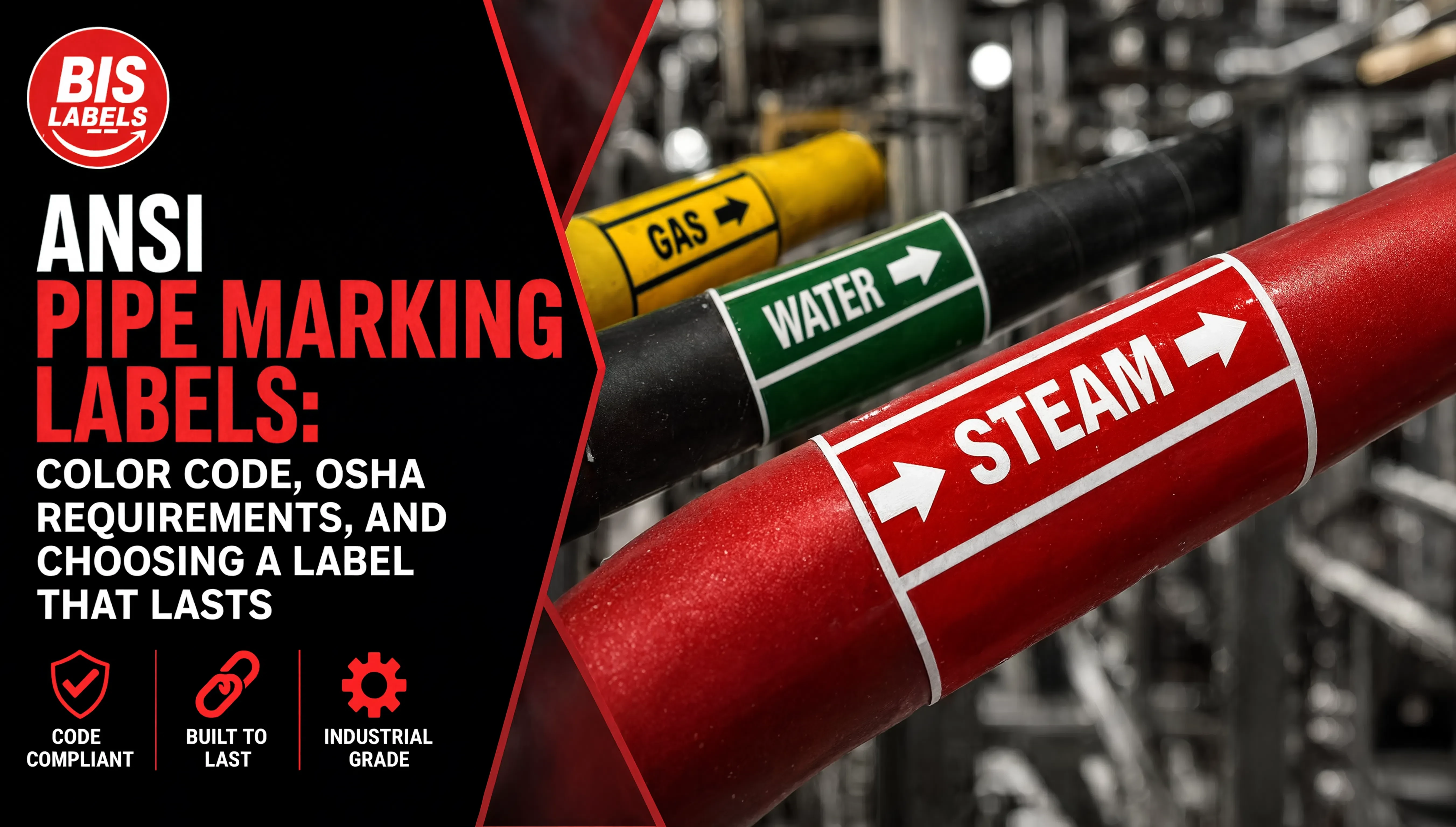
Unmarked pipes are a routine source of confusion on a plant floor, and during an emergency they are a genuine safety risk. A maintenance worker who cannot quickly tell a steam line from a compressed air line, or a firefighter who cannot identify what is flowing through a pipe before cutting into it, is working with information the facility should have provided at a glance. Pipe marking exists to close exactly that gap, and most facilities that fail an inspection over it are not confused about whether marking matters. They are confused about which standard applies to them and how to apply it correctly.
This is a facility identification question, related to but distinct from the container labeling covered in GHS Compliant Chemical Labels. GHS governs what goes on a chemical container. Pipe marking governs what goes on the piping system that moves those same materials through a facility, and it follows its own standard with its own color code.
What OSHA Actually Requires
OSHA does not have a single blanket rule requiring every pipe in every facility to be labeled. Federal OSHA only mandates pipe marking in a handful of specific situations, including certain welding operations, pulp and paper mill processes, and textile facilities, each of which points to the ANSI/ASME A13.1 standard by reference. Outside those specific regulations, general facility pipe marking is not federally mandated in most workplaces, though it may still fall under OSHA's General Duty Clause if unmarked piping creates a foreseeable hazard, and many state and local authorities layer additional requirements on top of the federal baseline.
In practice, most facilities that mark their pipes are not doing so because a single OSHA line item forces every pipe to carry a label. They are doing it because ANSI/ASME A13.1 is the recognized best-practice standard for reducing exactly the kind of confusion that leads to injuries, and because it is the standard an inspector, auditor, or insurer will expect to see followed if piping in the facility carries anything hazardous.
The ANSI/ASME A13.1 Standard, In Practice
ANSI/ASME A13.1 is the most widely used pipe identification standard in the United States, covering industrial plants, power facilities, and commercial or institutional buildings. It sets out five elements a compliant pipe label needs:
- Legend text identifying the pipe's contents by name, in bold, legible lettering
- Color coding that communicates the general hazard category of the contents at a glance
- Flow direction arrows showing which way the contents move through the pipe
- Label sizing appropriate to the pipe diameter and the distance from which it needs to be read
- Consistent placement at intervals and locations where the label will actually be seen during normal work
Reading the Color Code
The current A13.1 color scheme uses color to communicate the type of hazard a pipe's contents present, not just whether the contents are hazardous at all. Broadly, the standard groups pipe contents into categories such as flammable materials, combustible materials, toxic or corrosive materials, and materials that present a physical hazard like extreme temperature, along with categories for water and other low-hazard fluids. Facilities also have a set of user-defined color combinations available for materials that do not fit neatly into the standard categories, which is common in specialized manufacturing or process environments.
Because there have been multiple revisions to the standard over the years, and because the color assigned to a given hazard category has changed between editions, one of the most common pipe marking mistakes is a facility mixing pipe labels from different editions of the standard on the same site. Consistency across the whole facility matters as much as picking the correct color to begin with, since a mixed system defeats the purpose of a color code that is supposed to be read instantly.
Why Pipe Labels Fail Faster Than Most Other Facility Labels
Pipe marking labels face a specific combination of stress that most other plant labels do not:
Curved, cylindrical surfaces. Unlike a flat equipment panel or a drum, a pipe curves continuously around its circumference. A label without a flexible construction and an aggressive adhesive will lift at the edges first, then peel away entirely, especially on smaller-diameter pipe runs.
Heat and temperature cycling. Steam lines, process piping, and anything carrying heated or chilled material puts the label through repeated temperature swings that a standard adhesive was not built to hold through indefinitely.
Vibration. Pipe runs near pumps, compressors, or mechanical equipment vibrate continuously, which works against adhesive bond over time in the same way it does on the machinery itself.
Washdown and chemical exposure. Process piping in manufacturing environments is frequently washed down or exposed to the same chemical residue covered in Chemical & Heat-Resistant Labels for Metal Stamping and Foundry Facilities, which strips a standard label's print and adhesive just as fast on a pipe as it does on any other plant surface.
Choosing Label Material That Holds the Color Code
Because the color itself is the primary information a pipe marking label communicates at a glance, color consistency and fade resistance matter as much as legibility. A floodcoated color label stock, like Floodcoated Colors, builds the required color directly into the material rather than relying entirely on printed ink, which holds up better against fading from heat, sun, and repeated handling than a color that is only printed on the surface.
For the legend text, arrows, and any barcode or asset identifier included on the label, a durable synthetic face stock such as Polyester White Gloss keeps text legible through the same heat and handling exposure. And because pipe surfaces are curved and often exposed to washdown or vibration, an aggressive adhesive system like Hammerlock Adhesive is worth specifying rather than a general-purpose adhesive that was never built to hold on a cylindrical, moving surface.
A Practical Pipe Marking Checklist
- Confirm which standard applies to your facility, ANSI/ASME A13.1 is the default for most industrial and commercial sites, but check whether a federal, state, or local rule adds anything on top of it
- Use one consistent edition of the color code across the entire facility rather than mixing labels from different years or different suppliers
- Include all five required elements: legend text, color coding, flow arrows, appropriate sizing, and consistent placement
- Choose a label material built for curved, vibrating, or washdown-exposed surfaces rather than a flat-surface indoor label
- Re-audit labeling whenever piping is added, rerouted, or repurposed, since a label describing contents that changed is arguably worse than no label at all
Labels Built for the Plant Floor, Not Just the Inspection Binder
BIS Labels supplies floodcoated color label stock, durable polyester face stock, and high-tack Hammerlock adhesive systems built to hold their color and legibility on pipe runs, tanks, and other curved industrial surfaces. Browse Floodcoated Colors, Polyester White Gloss, and Hammerlock Adhesive, or request a quote and describe your facility's piping, contents, temperature range, and surface conditions, and our team will help you build a pipe marking program that still reads correctly years after it goes up.