
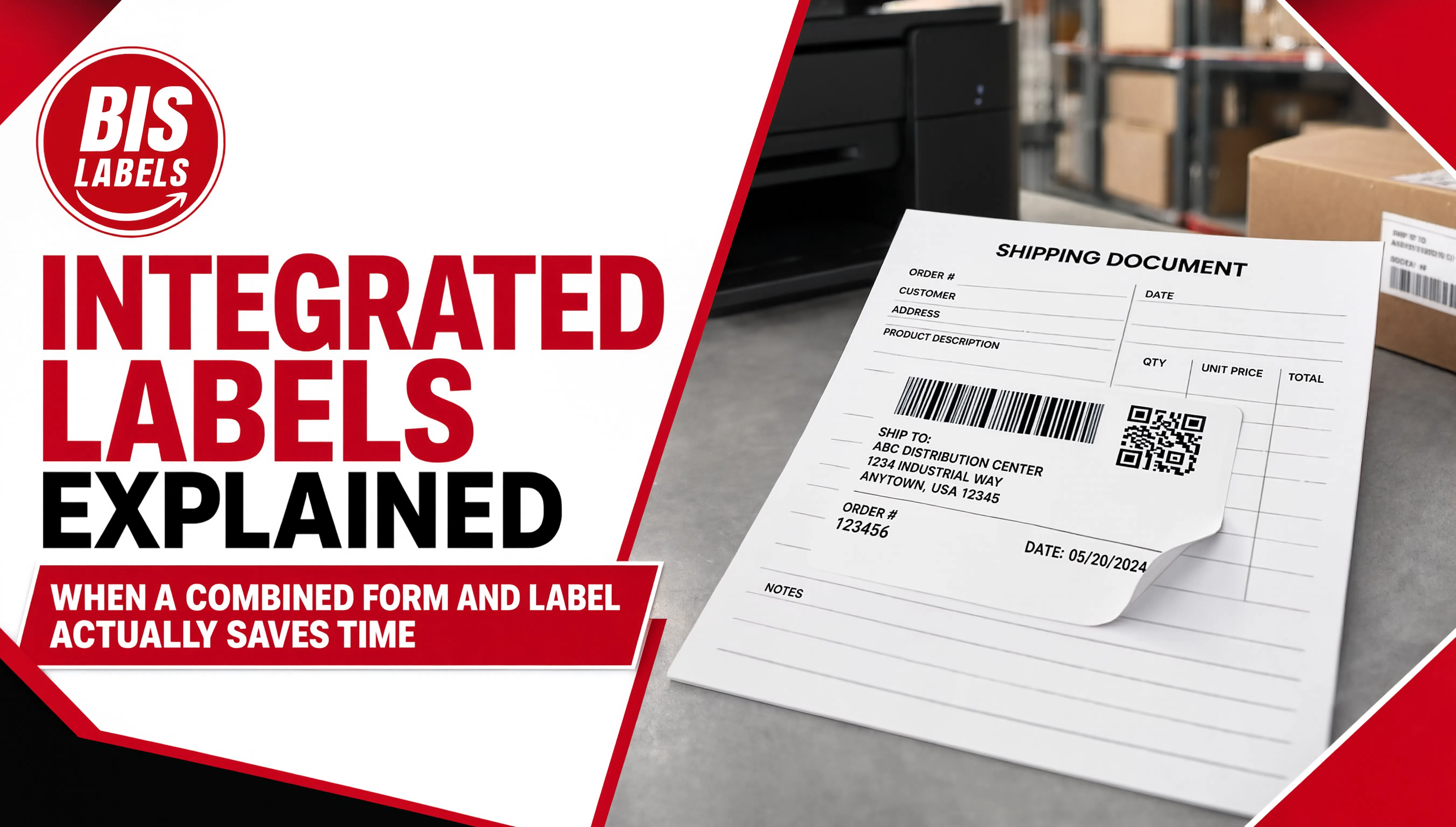
Most shipping and fulfillment workflows involve printing at least two separate things for every order: a shipping label and some kind of accompanying paperwork, whether that is a packing slip, an invoice, or an internal tracking sheet. Printing those as two separate jobs on two separate printers, then manually matching them back together before the label gets applied, is a small amount of friction that adds up fast at volume, and it is a common source of mismatched paperwork when an order runs behind or a printer jams mid-batch.
Integrated labels solve that specific problem by combining a printable document area and one or more peelable labels on a single sheet, printed in one pass through a standard laser or inkjet printer. This is a workflow and format question, distinct from the roll specifications covered in How to Read a Label Roll Spec Sheet, which deals with thermal roll labels rather than sheet-fed combination forms.
How an Integrated Label Sheet Works
An integrated label form is built on a standard 8.5 by 11 inch sheet, divided by a horizontal perforation into two sections: a document area at the top, printed with whatever paperwork the workflow requires, and one or more peelable labels at the bottom, printed with matching shipping or identification information in the same print job. Once printed, the sheet is separated along the perforation, and the label is peeled and applied directly to the package or item while the top section serves as the packing slip, invoice, or internal record.
Because both sections print together from the same file, there is no separate label print job to line up afterward, and no risk of a label and its paperwork getting separated or mismatched during a busy shift.
Where Integrated Labels Actually Save Time
High-volume order fulfillment. Warehouses and e-commerce operations printing dozens or hundreds of orders a day benefit most directly, since eliminating a second print job and a manual matching step compounds quickly at volume.
Multi-document workflows. Operations that need a packing slip, an invoice, and a shipping label all tied to the same order benefit from formats with multiple labels per sheet, keeping every document for that order physically linked from the moment it prints.
Mixed office and warehouse setups. Because integrated label sheets run through standard laser and inkjet printers rather than a dedicated thermal label printer, they fit naturally into fulfillment operations that are printing from a general office printer rather than a purpose-built label station.
Reducing mismatched paperwork. The core value proposition is accuracy: a label and its paperwork that print together and stay physically connected until they are separated are far less likely to end up on the wrong package than two documents printed separately and matched by hand.
Where a Dedicated Label Printer and Roll Stock Still Make More Sense
Integrated labels are not the right fit for every shipping workflow. Operations printing thousands of labels a day are usually better served by a dedicated thermal label printer and roll stock, since a sheet-fed laser or inkjet workflow does not scale as efficiently at that volume, and thermal transfer labels generally hold up to scanning and handling better over a package's full transit than a laser-printed label. Integrated labels are best suited to moderate-volume operations where the combination of a form and a label in one print job solves a real workflow problem, not as a wholesale replacement for a high-volume thermal labeling setup.
Choosing the Right Format
Integrated label forms come in several layouts, generally varying by how many labels appear per sheet and how much of the sheet is dedicated to the document area versus the label area:
- One label per sheet, full document area. Best for workflows needing a single shipping label alongside a detailed invoice or packing slip.
- Two or more labels per sheet. Suited to workflows that need a primary shipping label plus a secondary label for internal tracking, returns processing, or file identification.
- Pre-printed invoice format. Useful for standardizing the document area's layout across every order without reformatting it each time, similar to the consistency Pre Printed Labels offer for label content that repeats order after order.
Getting the Format Right the First Time
BIS Labels supplies Integrated Labels in a range of layouts, along with Laser Sheets for operations that need standard sheet labels without the combined document format. Request a quote and describe your order volume, how many documents need to travel with each shipment, and what printer your fulfillment station uses, and our team will help you match a format that actually removes a step from your workflow instead of just changing what the paperwork looks like.