Once a label buyer moves past paper, the next decision is usually between two synthetic face stocks that look nearly identical on the roll: polypropylene and polyester. Both are durable, both resist moisture better than paper, and both show up constantly in product spec sheets without much explanation of why one was chosen over the other. The two materials are not interchangeable, and picking the wrong one for a given application shows up later as a label that curls, cracks, or simply does not survive as long as the product it is attached to.
This is a material selection question, related to the outdoor and chemical exposure questions covered in Chemical & Heat-Resistant Labels for Metal Stamping and Foundry Facilities and Durable Asset Tag Labels. Those posts cover what conditions a label needs to survive. This one covers which base material gets you there.
What Actually Separates the Two Materials
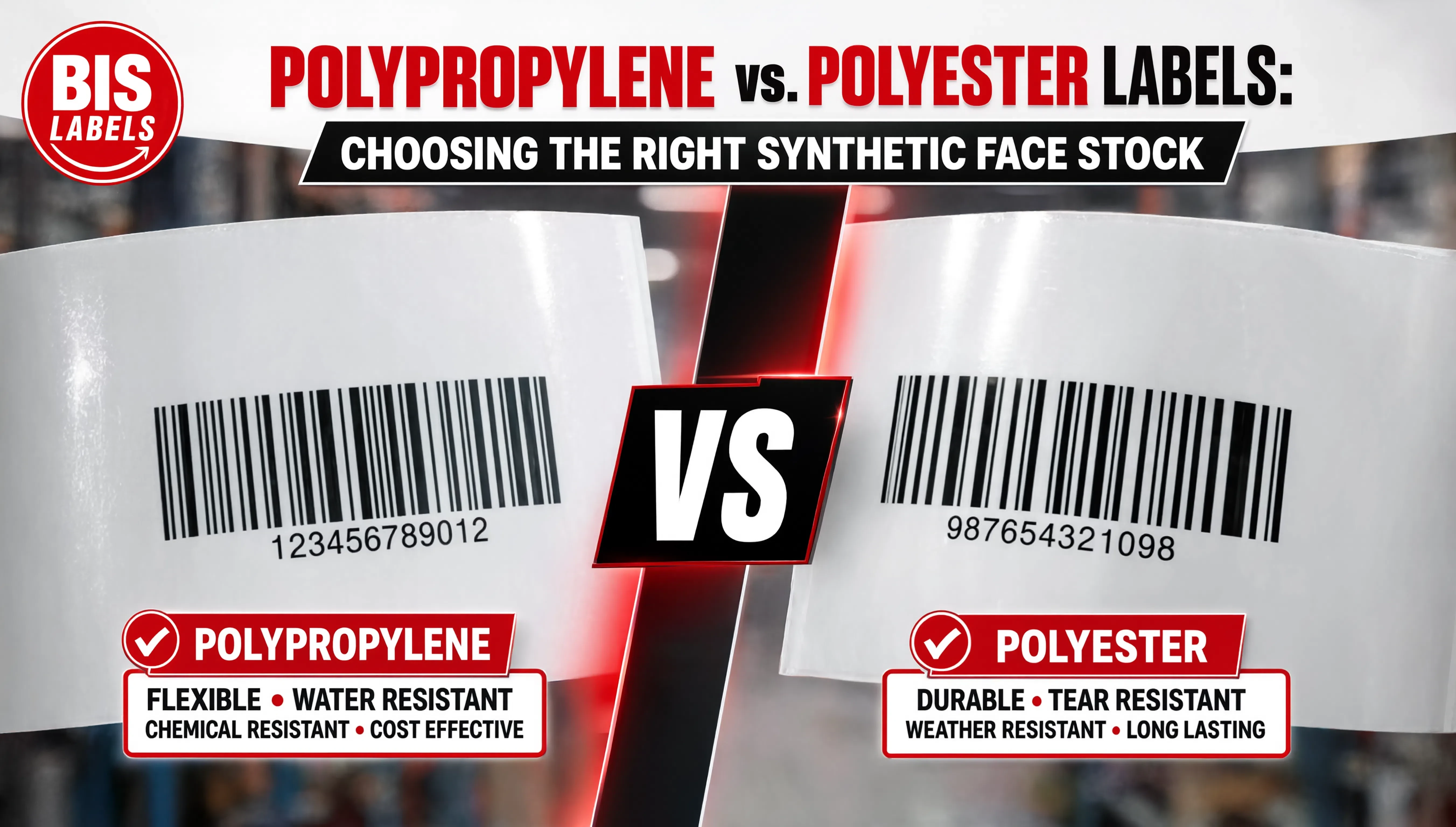
Polyester (PET) is a stiffer, higher-strength film with strong resistance to heat, chemicals, tearing, and UV exposure. It holds its shape well and does not stretch or distort under tension, which is why it is the standard choice for asset tags, equipment nameplates, and any label expected to stay legible for years. Its stiffness is also its main limitation: polyester does not conform well to tightly curved or heavily contoured surfaces, and it costs more per label than polypropylene.
Polypropylene (BOPP) is a softer, more flexible film that conforms easily to curved or irregular surfaces and offers good moisture and chemical resistance at a lower cost than polyester. It handles cold storage and general product labeling well, but it is less resistant to high heat and sustained UV exposure than polyester, and it will not match polyester's tear strength in heavy abrasion environments.
Neither material is universally better. The right choice depends on what the label needs to survive and what surface it needs to bond to.
When Polyester Is the Better Choice
- Outdoor and long-term durability. Equipment nameplates, asset tags, and anything expected to stay legible outdoors for several years benefit from polyester's UV and weathering resistance, covered in more depth in Durable Asset Tag Labels.
- High heat exposure. Labels going through a cure oven, near heat-generating equipment, or on parts that get hot during use hold up better on polyester.
- Abrasion-heavy handling. Labels on tools, equipment, or parts that get handled and stacked repeatedly benefit from polyester's higher tear and scratch resistance.
- Flat or gently curved surfaces. Because polyester is stiffer, it performs best on surfaces that do not require the label to wrap tightly around a small radius.
A gloss polyester face stock like Polyester White Gloss is a common default for exactly these applications, since it combines that durability with a smooth surface that holds barcode contrast well.
When Polypropylene Is the Better Choice
- Curved or contoured containers. Bottles, drums, tubes, and other rounded packaging benefit from polypropylene's flexibility, which lets it conform without the edges lifting the way a stiffer material can on a tight curve.
- Cold and freezer environments. Polypropylene generally performs well in refrigerated and frozen product labeling where moisture and condensation are the primary concern rather than heat or UV.
- Cost-sensitive, high-volume labeling. For general product labeling that does not need multi-year outdoor durability, polypropylene typically costs less per label while still outperforming paper.
- General indoor product identification. Where a label needs moisture resistance and a clean appearance but is not exposed to heat, sustained sun, or heavy abrasion, polypropylene is usually the more economical fit.
Polypropylene label stock is a straightforward choice for these applications, particularly where the container shape rules out a stiffer material.
Adhesive Still Has to Match the Surface
Choosing the right face stock only solves half the problem. Polypropylene's flexibility helps it conform to curved surfaces, but if the adhesive underneath is not aggressive enough for that same curve, oily residue, or textured surface, the label will still lift regardless of which film sits on top. A high-tack adhesive system like Hammerlock Adhesive is built for exactly that combination of difficult surfaces, whether the face stock on top is polypropylene or polyester.
A Quick Way to Decide
Ask two questions before ordering:
- Does the label need to survive heat, UV, or heavy abrasion for years, or is it labeling a product for a shorter shelf life indoors? Long-term, high-stress applications point toward polyester. Shorter-term or indoor applications often do just as well on polypropylene at a lower cost.
- Is the surface flat or gently curved, or does it wrap tightly around a small-diameter container? Tight curves favor polypropylene's flexibility. Flatter or larger-radius surfaces can use either material without a conformability problem.
Material Matched to the Application, Not Just the Price Sheet
BIS Labels stocks both polyester and polypropylene face stocks, along with the adhesive systems needed to make either one perform on the surface it is actually applied to. Browse Polyester White Gloss, Polypropylene, and Hammerlock Adhesive, or request a quote and describe your container shape, exposure conditions, and expected label life, and our team will help you pick the material that actually fits.