
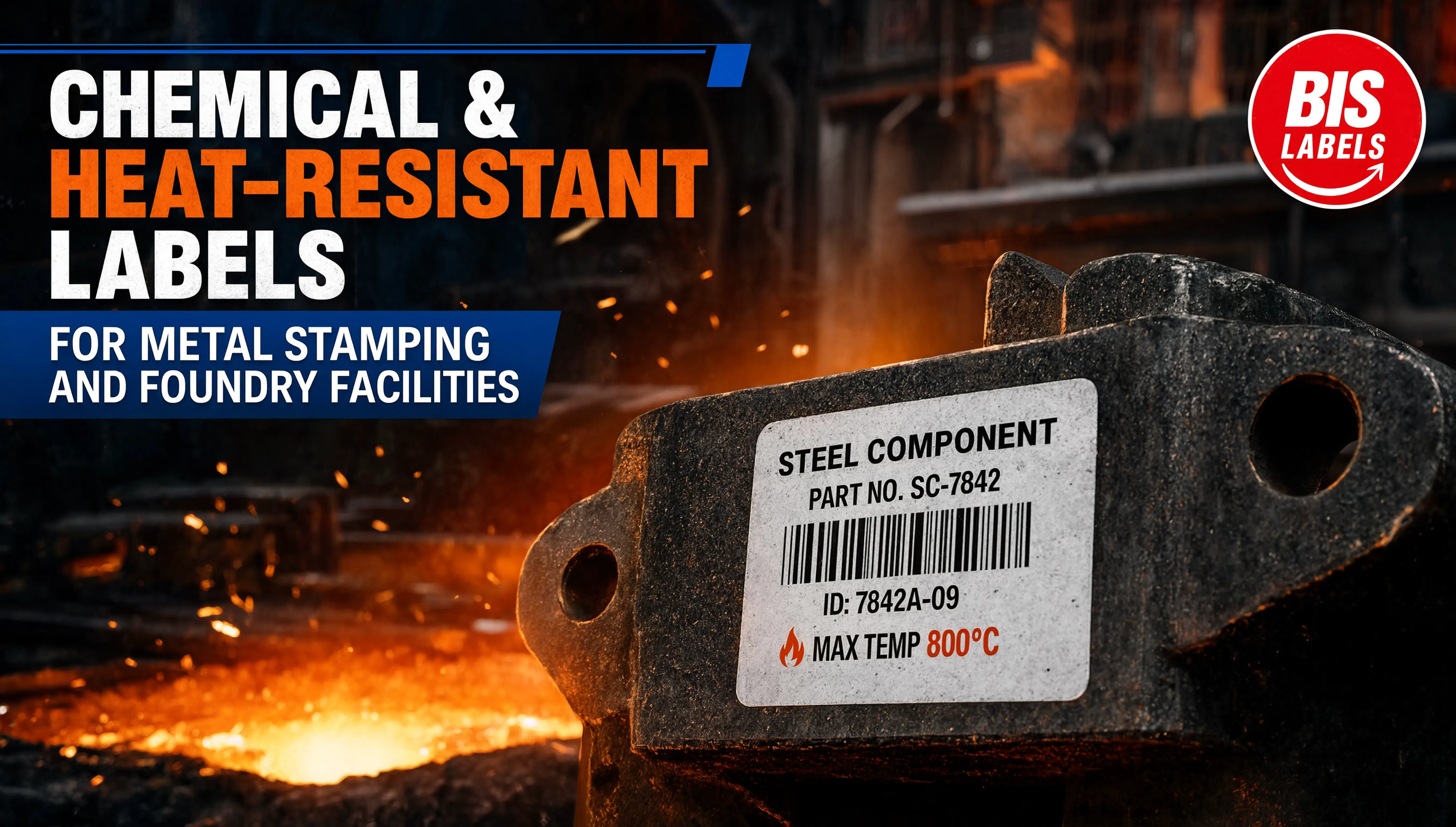
Heavy manufacturing environments, metal stamping plants, foundries, machining shops, and fabricated metal facilities across hubs like Cleveland, Akron, Pittsburgh, Chicago, Gary, and Milwaukee, put more physical and chemical stress on a label than almost any other industrial setting. Cutting fluid, stamping oil, high-temperature curing processes, and constant abrasion from handling will strip a standard commercial label’s readability within days, sometimes hours. For a facility that depends on that label for inventory tracking, quality documentation, or parts identification, a label failure isn’t cosmetic, it’s a break in the chain of information the shop floor runs on.
This is a substrate and adhesive survivability question, distinct from the ribbon-grade question covered in Wax vs. Resin vs. Wax-Resin Ribbons Explained, that post is about print quality and how the image is applied to the label; this one is about whether the label itself, as a physical material, can survive the environment it’s placed in.
What Heavy Manufacturing Environments Actually Do to a Label
Oil and cutting fluid. Stamping presses, CNC machining, and metal forming operations routinely coat parts, and anything attached to them, in cutting fluid, stamping oil, or coolant. Standard paper labels absorb these fluids, causing the adhesive to fail and the print to smear or become illegible. Even labels that survive initial exposure often degrade further over the following days as fluid continues to wick into the material.
High-temperature curing and processing. Powder coating, e-coating, and various thermal treatment processes expose labels to sustained heat well beyond what standard adhesives and face stocks are rated for. A label that looks fine going into a cure oven can blister, discolor, lose adhesion, or have its barcode contrast degrade coming out, sometimes to the point of being unreadable exactly when the part reaches the next station that needs to scan it.
Abrasion from handling and stacking. Parts moving through multiple production stages, stamping, forming, machining, inspection, packaging, get handled, stacked, and repositioned constantly. Labels without an abrasion-resistant surface wear through print and lose legibility well before the part reaches final shipment.
Foundry-specific heat and particulate exposure. Foundry environments add another layer: ambient heat from casting and cooling processes, along with fine particulate from sand casting or grinding operations, that can obscure or degrade standard labels faster than in a typical machining or stamping shop.
Substrate: Why Synthetic Face Stock Outperforms Paper Here
Paper-based labels, even with a protective coating, generally aren’t built to withstand sustained oil exposure, high heat, or heavy abrasion. Polyester and polypropylene face stocks hold up dramatically better across all of these stressors, polyester in particular offers strong resistance to heat, chemicals, and abrasion, which is why it’s the standard substrate choice for asset tags, equipment nameplates, and labels that need to survive years of industrial handling rather than days.
A gloss polyester face stock combines that chemical and heat resistance with a smooth print surface that holds barcode contrast well, which matters directly for scan reliability, a label that’s physically intact but has lost print contrast from heat or abrasion still fails the same way an outright destroyed label does: it doesn’t scan.
Adhesive: Matching the Bond to the Surface
Heavy manufacturing surfaces are frequently oily, textured, curved, or otherwise difficult for a standard adhesive to bond to reliably, and a label that’s chemically and thermally resistant but physically falls off the part has failed just as completely as one that degraded in place. High-tack, aggressive adhesive systems built specifically for difficult surfaces are designed to hold through oil film, temperature cycling, and rough handling that would lift a general-purpose adhesive within a shift. This is the same adhesive consideration covered in more automotive-specific detail in VIN & Parts Traceability Labels for Automotive Tier-1 Suppliers, since automotive stamping and metal forming operations face nearly identical adhesion challenges.
Print Quality That Survives the Environment, Not Just Looks Good on Day One
Beyond substrate and adhesive, the printed image itself needs to resist smudging from oil contact and abrasion from handling, which is where smudge-resistant label constructions and appropriately matched ribbon grades come in. A label built on the right substrate with the right adhesive can still fail if the print itself smears the first time it’s touched with an oily glove, which is why substrate, adhesive, and print method need to be selected together rather than as separate decisions.
Choosing the Right Combination for Your Application
|
Exposure Type |
What Fails on Standard Labels |
What to Look For |
|
Cutting fluid / stamping oil |
Adhesive fails, print smears |
Polyester/polypropylene face stock, oil-resistant adhesive |
|
High-temp curing (powder coat, e-coat) |
Blistering, discoloration, adhesion loss |
Heat-rated face stock and adhesive system |
|
Abrasion from handling |
Print wears through, barcode fails |
Smudge-resistant print surface, resin-grade ribbon |
|
Oily, textured, curved metal surfaces |
Label lifts or peels off entirely |
High-tack aggressive adhesive |
A Practical Way to Approach It
Rather than defaulting to whatever label your facility has always used, it’s worth mapping the label against the specific exposure it will actually face: does it go through a cure oven? Is the mounting surface oily or textured? Will it be handled repeatedly before final shipment? Each of those answers points toward a different substrate, adhesive, or print combination, and getting it right up front is far cheaper than reprinting a production run that failed halfway through the process.
Labels Built for the Shop Floor
BIS Labels supplies polyester and polypropylene label materials, high-tack Hammerlock adhesive systems, and smudge-resistant constructions built for the oil, heat, and abrasion typical in metal stamping and foundry environments. Browse Polyester White Gloss, Hammerlock Adhesive, and Smudge Proof labels, or request a quote and describe your process, cure temperatures, fluid exposure, mounting surface, and our team will help you match a label built to survive it.