
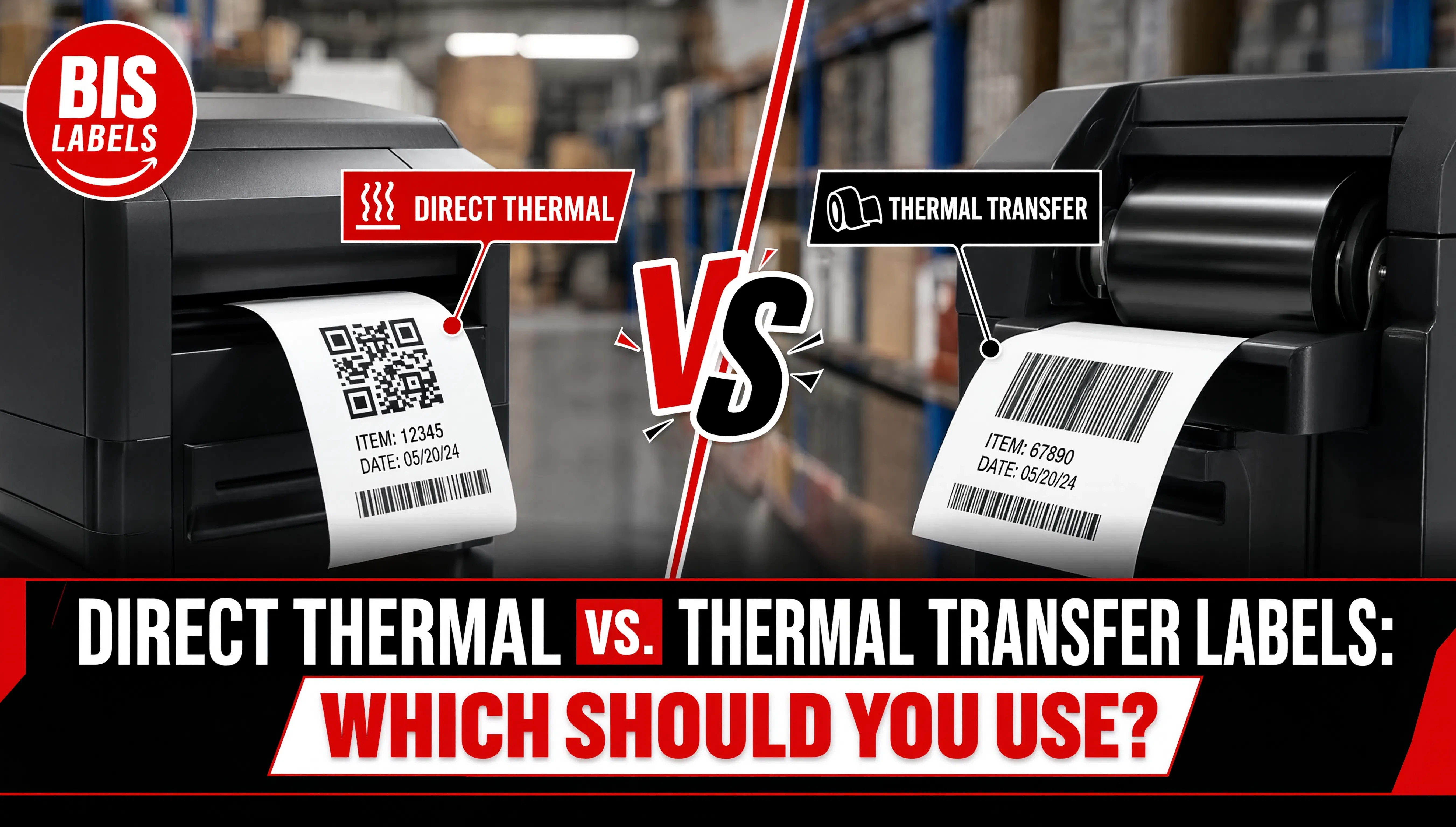
If you print barcode, shipping, or inventory labels, you've probably run into two very different-sounding label types on every supplier's site: direct thermal and thermal transfer. They can look nearly identical on the roll, they run on similar printers, and the terminology gets thrown around loosely enough that a lot of buyers end up guessing, or worse, ordering based on whatever the last supplier sold them.
The two technologies solve different problems. Picking the wrong one doesn't usually show up on day one; it shows up three weeks later, when a shipping label has faded to the point a carrier can't scan it, or when a customer complains that a returned product's label is unreadable. This guide breaks down how each technology actually works, where each one holds up (and where it doesn't), and gives you a straightforward way to decide which belongs on your next order.
The Core Difference: Heat Alone vs. Heat + Ribbon
Both direct thermal and thermal transfer printers use a thermal printhead, a row of tiny heating elements that the label stock passes under. From there, the two methods diverge completely.
Direct thermal labels are chemically treated. The face stock itself contains a heat-sensitive coating that darkens when the printhead touches it. No ink, no toner, no ribbon, the printhead is the entire printing mechanism. That's why direct thermal printers are simpler and cheaper to run: fewer consumables, fewer moving parts, less to go wrong.
Thermal transfer labels are printed on plain, uncoated face stock. The image comes from a separate ribbon coated with wax, resin, or a wax-resin blend, positioned between the printhead and the label. The printhead melts the ribbon's coating onto the label material, transferring the image the same way a typewriter ribbon transfers ink, just with heat instead of an impact strike. This is why thermal transfer requires you to buy and match a compatible ribbon (a topic we cover in Wax vs. Resin vs. Wax-Resin Ribbons Explained, if you're at that stage of the decision).
That single mechanical difference, heat alone vs. heat plus a consumable ribbon, is what drives every practical difference between the two below.
Where Each One Falls Apart (or Doesn't)
Direct thermal labels fade over time
Because the image lives in the coating itself, that same coating keeps reacting to anything that generates heat or UV exposure after printing, direct sunlight through a warehouse window, a label sitting on a dashboard, a heat-sealed shrink-wrap process, or simply months of ambient warmth in storage. Over weeks or months, the print darkens, blurs, or fades to the point a scanner can't read it. Friction and moisture cause similar problems, since there's no protective topcoat holding the image on the surface.
This isn't a defect, it's how the chemistry is designed to work. It's exactly why direct thermal is the standard for short-lived labels: a shipping label that gets scanned a handful of times over one to two weeks before the box reaches its destination, a retail price tag, a lab specimen label used same-day, or a receipt. If the label's useful life is measured in days or a couple weeks, direct thermal's fade characteristics are irrelevant, the label has already done its job.
Thermal transfer labels are built for the long haul
Because the ribbon deposits wax, resin, or a wax-resin blend onto the label surface rather than reacting with it, the print is far more resistant to light, heat, abrasion, chemicals, and moisture, and the resistance level depends entirely on the ribbon grade selected. A wax ribbon on a paper label gives you solid barcode durability for general warehouse and retail use. A resin ribbon on a polyester or polypropylene label can survive outdoor exposure, solvent contact, and temperature swings that would destroy a direct thermal label within days.
This makes thermal transfer the right call for anything that needs to stay legible for weeks, months, or the life of the asset: pallet and rack labels, equipment/asset tags, outdoor signage, chemical drum labels, product labels that sit on a shelf for a season, or any barcode that will be rescanned repeatedly over a long period.
Direct Thermal vs. Thermal Transfer: Quick Decision Checklist
| Factor | Direct Thermal | Thermal Transfer |
|---|---|---|
| Consumables | None, label only | Label + matched ribbon |
| Typical lifespan | Days to a few weeks | Months to years, ribbon-dependent |
| Best for | Shipping labels, receipts, short-term retail tags, same-day use | Asset tags, outdoor labels, compliance labels, long-shelf-life products |
| Sensitivity | Fades with heat, sunlight, friction | Resistant to heat, chemicals, abrasion (grade-dependent) |
| Running cost | Lower per-label cost, fewer parts to manage | Slightly higher per-label cost due to ribbon, but far more durable |
| Print head wear | Direct contact wear over high volumes | Ribbon acts as a buffer, can extend print head life |
A simple way to frame it for your own operation: ask how long the label needs to survive, not how long the box needs to survive. A label that ships same-day and gets scanned once at receiving doesn't need thermal transfer's durability. A label on a piece of equipment that will be scanned monthly for the next three years absolutely does.
A Few Edge Cases Worth Flagging
- High-volume shipping operations sometimes still choose thermal transfer even for short-lived labels, because the ribbon reduces direct printhead wear and can extend the life of the print engine on machines running heavy daily volume.
- Cold storage and freezer environments can affect both technologies differently depending on the adhesive and face stock, this is a separate consideration from the print method itself and worth reviewing with your label supplier for the specific temperature range involved.
- Mixed fleets are common: many operations run direct thermal for outbound shipping labels and thermal transfer for internal asset tags and compliance labeling on the same shop floor, using two printer types (or dual-capable printers) side by side.
Getting the Roll Specs Right, Either Way
Once you've settled on the print method, the next decision, core size, outer diameter, and how the label senses in your printer, matters just as much for avoiding downtime. We cover that in detail in How to Read a Label Roll Spec Sheet, so you order stock that actually fits your printer on the first try.
Talk to BIS Labels About Your Application
BIS Labels has supplied thermal label stock and ribbons from U.S. inventory since 1992, and our team routinely helps buyers work through exactly this decision before an order goes out, not after a batch of labels fails in the field. Browse our Direct Thermal and Thermal Transfer lines, or request a quote and tell us how the label will actually be used; we'll help you land on the right material and grade the first time.