
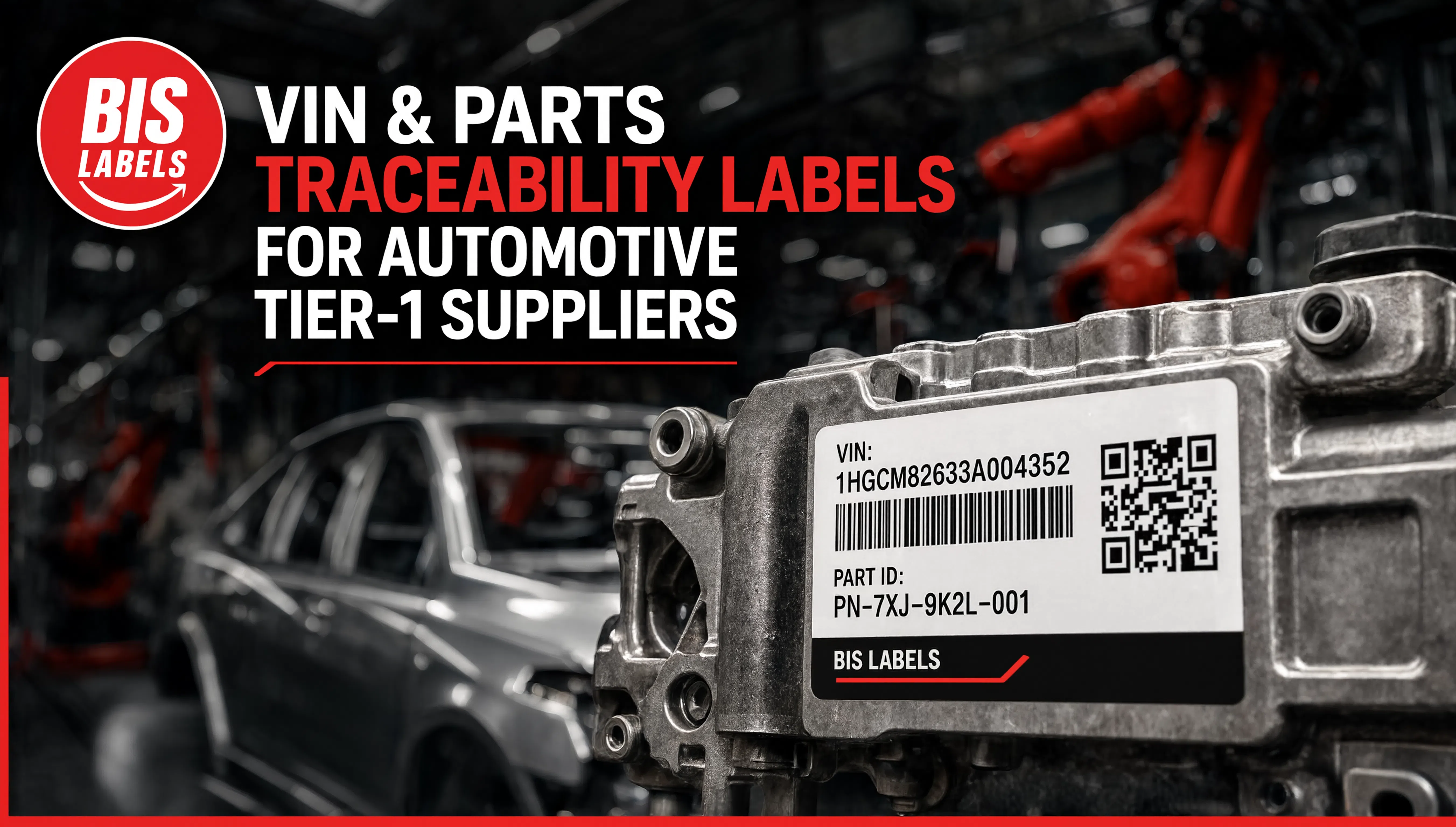
Automotive OEMs run some of the most unforgiving traceability requirements of any industry, and for good reason: a single defective part, once it's built into a vehicle, needs to be traceable back to the exact production lot, shift, and supplier that made it, potentially years later, potentially across a recall affecting hundreds of thousands of vehicles. That entire system depends on a label surviving conditions most labels were never designed for: engine bay heat, cutting fluid, stamping oil, powder coat ovens, and years sitting on a part that may never be handled again after it leaves the line.
For Tier-1 and Tier-2 suppliers shipping into assembly plants across the Michigan, Ohio, Indiana, Kentucky, Tennessee, Alabama, and South Carolina automotive corridors, getting the label wrong isn't a minor quality issue, it's a line-down risk, a chargeback, or in the worst case, a part that becomes untraceable if something goes wrong downstream. This guide covers what OEMs typically require, why standard commercial labels usually can't meet it, and what to look for in a label built for the plant floor rather than the warehouse.
What "Traceability" Actually Requires on a Part Label
Traceability isn't a single barcode, it's a chain of identifying data that has to stay both physically attached to the part and electronically consistent with the supplier's quality records, from the moment it's printed until the part is installed (and often for years after, in case of a recall). In practice, a compliant parts traceability label typically needs to carry:
- Part number identifying the exact component
- Lot or batch number tying the part back to a specific production run
- Date/shift code identifying when and on which line the part was made
- Supplier code identifying which Tier-1 or Tier-2 facility produced it
- A scannable barcode (commonly Code 39, Code 128, or a 2D Data Matrix, depending on the OEM's specification) encoding that same data for automated scanning at receiving and on the assembly line
Most major OEMs specify these requirements through supplier labeling standards, AIAG (Automotive Industry Action Group) labeling guidelines are the most widely referenced baseline, though individual OEMs often layer their own specific requirements on top. The label isn't just informational; it's the physical link between a part and the electronic quality record that has to exist for that part's entire traceable life.
Why Standard Commercial Labels Fail in Automotive Environments
A label that performs perfectly in a distribution warehouse can fail within days on a stamped metal part or an under-hood component, for reasons that have nothing to do with barcode quality:
Oil and coolant exposure. Stamping, machining, and assembly operations routinely expose parts, and the labels on them, to cutting fluid, stamping oil, and coolant. Standard paper labels and general-purpose adhesives can delaminate, smear, or lose adhesion entirely when saturated with oil, taking the traceability data with them.
Heat exposure. Parts headed for powder-coat ovens, e-coat processes, or under-hood installation locations see sustained heat that standard label adhesives and print methods aren't rated for. A label that looks fine coming off the press can blister, discolor, or lose barcode contrast after a cure cycle.
Rough or low-surface-energy substrates. Cast, stamped, or machined metal surfaces, sometimes oily, textured, or curved, don't hold a standard adhesive the way a flat cardboard carton does. A label that peels off mid-transit or mid-assembly doesn't just look bad; it breaks the traceability chain for that part entirely, which is a far more serious problem than a smudged shipping label.
Abrasion during handling. Parts moving through multiple stations, fixtures, and handling steps before final assembly put more physical wear on a label than almost any other supply chain environment. Barcodes need to stay scannable after that handling, not just at the moment of printing.
This is the same underlying substrate-survivability problem covered in more depth in Chemical & Heat-Resistant Labels for Metal Stamping and Foundry Facilities, automotive parts traceability is a specific, high-stakes application of that broader durability requirement, with the added pressure of OEM-mandated data accuracy on top of physical survivability.
What to Look for in a Parts Traceability Label
Aggressive, application-specific adhesive. Oily, textured, or curved metal surfaces need an adhesive rated for exactly those conditions, not a general-purpose adhesive that happens to work on cardboard. High-tack adhesive systems built for difficult surfaces are designed to hold through oil exposure, temperature swings, and handling that would lift a standard label within hours.
Substrate rated for the part's environment. Polyester and polypropylene face stocks generally outperform paper in automotive applications because they resist oil, moisture, and abrasion far better, but the specific grade still needs to match the part's actual exposure (a stamped bracket headed for powder coat has different requirements than a wiring harness component that will sit in a passenger compartment).
Thermal transfer print with resin or wax-resin ribbon. Given the chemical and abrasion exposure typical in automotive manufacturing, thermal transfer printing with a resin or wax-resin ribbon is almost always the right call over direct thermal, the part's traceability life is measured in years, not days, and the barcode needs to survive handling and environmental exposure the entire time.
Barcode verified against the OEM's actual spec, not a generic quality check. Different OEMs and even different plants within the same OEM can specify different barcode symbologies, minimum verification grades, and label placement requirements. A label that passes a general barcode scan doesn't necessarily meet a specific customer's supplier routing guide, that's worth confirming against the actual spec before a production run, not after a rejected shipment.
A Practical Starting Checklist for Suppliers
Before finalizing a parts traceability label for a new program or part number, it's worth confirming:
- Which barcode symbology and data structure the receiving OEM requires (AIAG baseline, plus any OEM-specific additions)
- What environmental exposure the label will face after leaving your facility, heat, oil, powder coat, outdoor storage, not just conditions inside your own plant
- Whether the mounting surface is oily, textured, curved, or otherwise non-standard, which determines adhesive selection
- Whether print method (thermal transfer, ribbon grade) matches how long the label needs to remain scannable
- Whether your current label supplier can support the print volume and lead times your production schedule requires without becoming a bottleneck
Built for the Plant Floor, Not Just the Shipping Dock
BIS Labels supplies high-tack adhesive label stock, including our Hammerlock line, built for surfaces standard adhesives won't hold to, alongside thermal transfer materials suited to oil, heat, and abrasion exposure typical in automotive manufacturing. Browse Hammerlock Adhesive Labels and Thermal Transfer, or request a quote and tell us about the part, the surface, and the environment it's headed into, we'll help you match a label that stays traceable for the part's full life, not just through your own facility.