
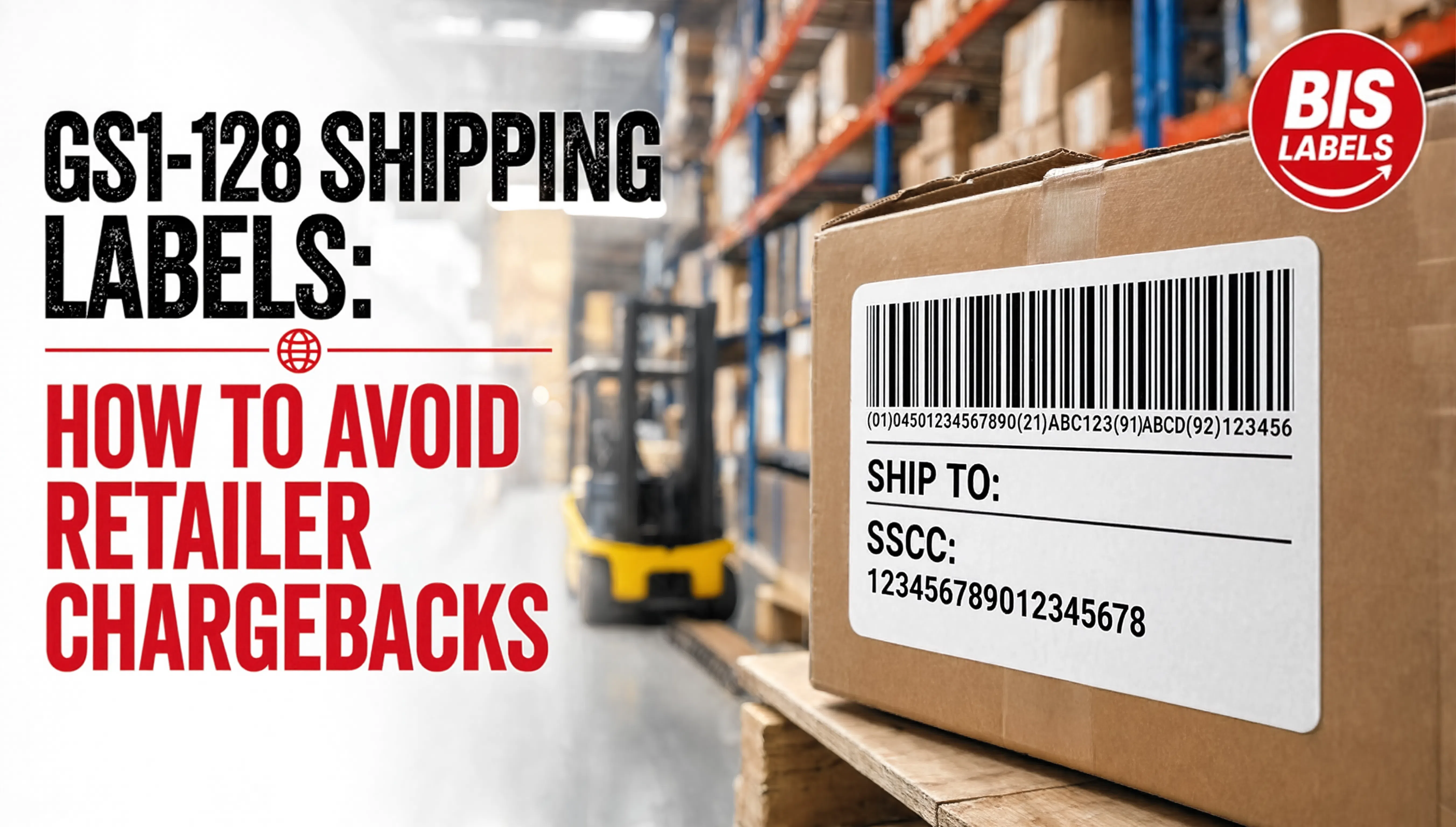
Ask any distribution manager who ships to a major retailer where their chargeback fees actually come from, and labeling comes up almost every time. Not damaged goods, not late trucks, a barcode that won't scan, a serial shipping container code that doesn't match the advance ship notice, or a label placed in the wrong spot on the carton. Individually these look like small errors. At scale, across thousands of cartons a month, they add up to real money leaving the business on fees that were entirely preventable.
Most of these chargebacks trace back to one root cause: the shipping label wasn't actually GS1-128 compliant, even if it looked correct to the naked eye. This guide covers what GS1-128 compliance actually requires, the barcode symbology, the SSCC structure, and label placement, and the specific gaps that trigger chargebacks most often.
What "GS1-128 Compliant" Actually Means
GS1-128 (formerly known as UCC/EAN-128) isn't a label design, it's a barcode standard maintained by GS1, the global organization that governs supply chain identification. A label is GS1-128 compliant when it correctly encodes standardized data using Application Identifiers (AIs), a system of numeric prefixes that tell scanning systems exactly what kind of data follows in the barcode: a shipping container code, a quantity, a lot number, a ship date, and so on.
This matters because GS1-128 labels aren't read in isolation. A retailer's receiving system cross-references the barcode data against the Advance Ship Notice (ASN) your company transmitted electronically before the shipment arrived. If the barcode on the carton doesn't match what the ASN told the retailer to expect, wrong AI formatting, a missing check digit, an SSCC that doesn't parse correctly, the system flags a discrepancy, and that discrepancy is exactly what generates a chargeback, independent of whether the physical goods inside the carton are correct.
The SSCC: The Core of Carton-Level Compliance
The single most important element on a GS1-128 shipping label is the Serial Shipping Container Code (SSCC), encoded under Application Identifier (00). The SSCC is an 18-digit number that uniquely identifies that specific carton or pallet, not the product inside it, and not the order it belongs to, but that exact physical unit, once, in the entire GS1 numbering system.
An SSCC is built from four components:
- Extension digit, a single digit used to expand the numbering capacity of the identifier
- GS1 Company Prefix, the unique prefix assigned to your company by GS1
- Serial reference number, a sequential or unique number your company assigns per carton
- Check digit, a calculated digit that lets scanning systems verify the SSCC wasn't corrupted or misread
If any of these components are malformed, a check digit calculated incorrectly, a company prefix that doesn't match your registered GS1 account, or a serial reference that gets reused, the SSCC won't validate against the ASN, and that carton becomes a labeling discrepancy the moment it hits the retailer's dock.
Common Reasons Retailers Issue Labeling Chargebacks
Barcode won't scan at required quality. Most major retailers specify a minimum barcode grade (commonly referencing ANSI/ISO grading standards) that the printed barcode must meet, not just "readable to a person," but readable reliably by dock-level scanning equipment on the first pass. Print contrast, bar width tolerance, and quiet zone spacing around the barcode all factor into that grade. A barcode that scans fine on a handheld unit in your own warehouse can still fail a retailer's automated conveyor scanner if the print quality is marginal.
SSCC doesn't match the ASN. This is the most common compliance failure and usually stems from a systems issue rather than a printing issue, the label was generated correctly, but the ASN transmission used a different or outdated SSCC. Since retailers reconcile the physical label against the ASN automatically, any mismatch generates a discrepancy regardless of which system was "right."
Label placement is inconsistent or non-compliant. Most retailer routing guides specify exactly where the GS1-128 label must be placed on the carton, typically a defined distance from a specific edge, on a particular face of the box, oriented a particular way. Labels placed inconsistently, at an angle, or wrapped around a carton edge (which distorts barcode geometry) frequently fail automated scanning even when the barcode itself is technically correct.
Wrong or missing Application Identifiers. Beyond the SSCC, many retailer routing guides require additional AIs on the same label, quantity (AI 37), lot number (AI 10), or ship date (AI 11), among others. Omitting a required AI, or using the wrong AI prefix for the data it represents, is read by the retailer's system as either missing information or corrupted data.
Label material and adhesive failure in transit. A GS1-128 label is only compliant as long as it's readable when it reaches the dock. Labels on paper stock with a low-tack adhesive can peel, wrinkle, or smear during multi-leg freight moves, particularly on cartons exposed to temperature swings or handled repeatedly. This is a substrate and print-method decision as much as a barcode-design decision; see Direct Thermal vs. Thermal Transfer Labels for how label durability factors into which labels hold up through a full shipping cycle.
A Practical Pre-Shipment Checklist
Before a batch of GS1-128 labels goes on outbound cartons, it's worth confirming:
- The SSCC's GS1 Company Prefix matches your company's registered GS1 account
- Serial reference numbers are not being reused within their required uniqueness window
- The barcode meets the specific verification grade required by the retailer's routing guide (this varies by retailer, check the current guide, not last year's)
- All required Application Identifiers for that retailer are present and correctly formatted
- Label placement matches the retailer's specified location, orientation, and distance from carton edges
- The label substrate and adhesive are rated for the shipment's expected handling and environmental conditions
- ASN data was generated from the same source as the printed labels, not a separate manual entry step
Where Barcode Technology Choice Comes In
GS1-128 compliance is fundamentally about carton-level barcode identification, a separate question from whether your warehouse should be moving toward RFID for inventory tracking. If you're evaluating whether RFID makes sense alongside or instead of barcode labeling for your operation, RFID vs. Barcode Labels: Which Is Right for Your Warehouse? covers that decision separately from carton-compliance labeling.
Print Durable, Scan-Grade Compliant Labels
BIS Labels supplies thermal transfer label stock built to hold up through multi-leg freight moves without the smudging or peeling that turns a technically-correct barcode into a chargeback. Browse our Thermal Transfer line, or request a quote and tell us which retailer routing guide you're printing against, we'll help you match label material and print quality to what that retailer's dock scanners actually require.