
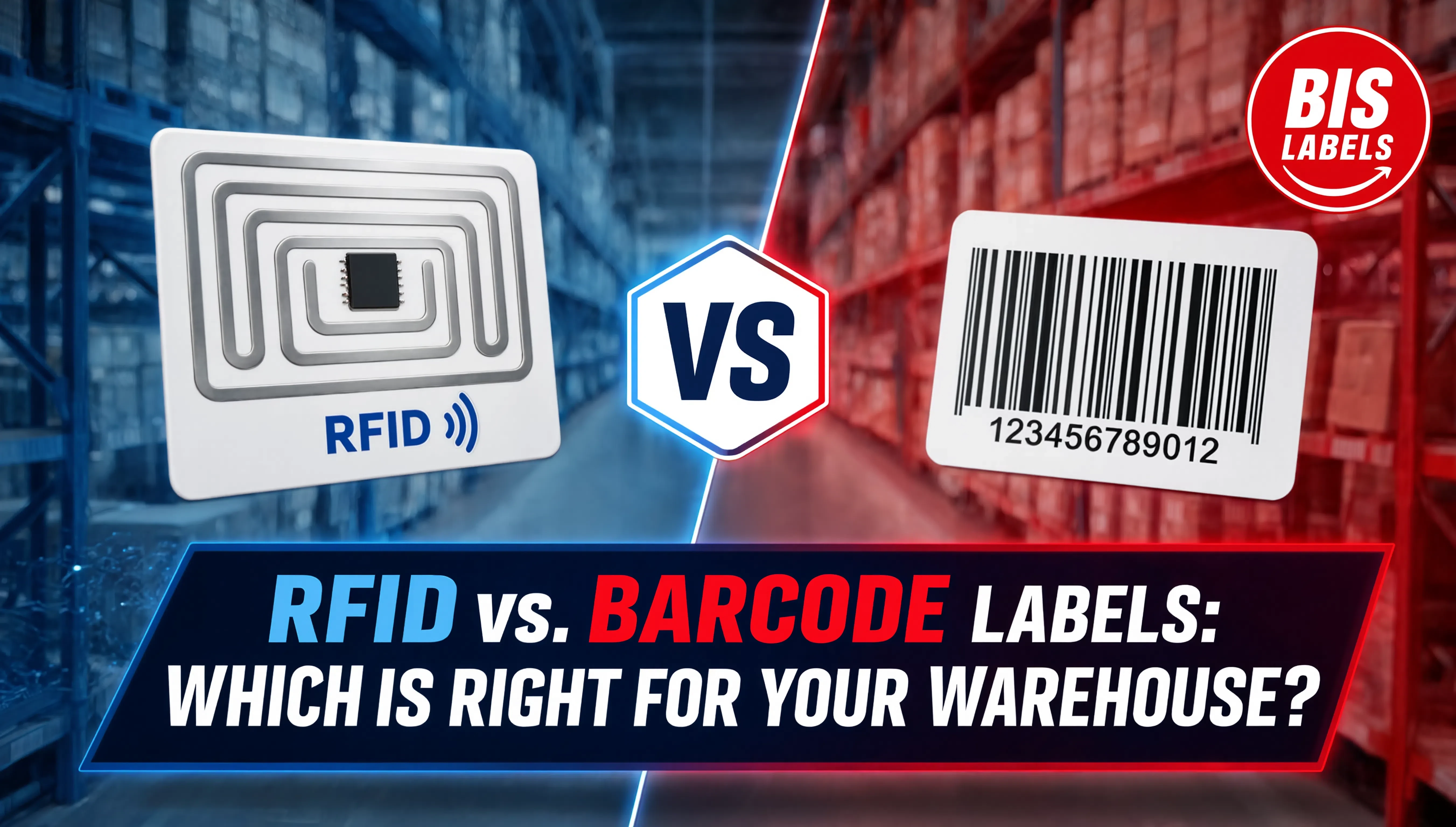
Every few years, RFID gets pitched to warehouse and distribution operators as the technology that will finally replace barcode scanning. It hasn’t and for most operations, it isn’t going to, at least not entirely. What’s actually happened is that RFID has carved out a solid role alongside barcode labeling rather than displacing it, and the operations getting real value from RFID are the ones that picked it for the right application rather than as a blanket upgrade.
This is a different question from carton-level compliance labeling if you’re trying to figure out what makes a shipping label GS1-128 compliant, that’s covered separately in GS1-128 Shipping Labels: How to Avoid Retailer Chargebacks. This post is about the underlying identification technology itself: when RFID’s added cost is worth it, and when a barcode label does the job just as well for a fraction of the price.
How the Two Technologies Actually Differ
A barcode label is passive in the truest sense, it’s ink or a thermal image on a surface, and it only conveys information when a scanner has a direct line of sight to it and is aimed correctly. Reading a barcode is a one-at-a-time operation: one label, one scan, one line of sight.
An RFID tag embeds a small chip and antenna into the label that communicates with a reader over radio frequency. No line of sight is required, and depending on the reader and tag type many RFID tags can be read simultaneously within range, rather than one at a time. That fundamental difference (line-of-sight, one-at-a-time vs. no-line-of-sight, bulk-read) is what drives every practical tradeoff below.
Where RFID Earns Its Cost
Bulk reads without individual scanning. The clearest RFID win is when you need to read many items at once without physically scanning each one, a pallet passing through a dock door, a cart of mixed inventory moving through a portal reader, or a full truckload verified in seconds rather than scanned item by item. If your operation is bottlenecked on scan time at receiving or shipping, this is where RFID’s ROI case is strongest.
No-line-of-sight environments. Barcode labels have to be visible and properly oriented to scan. RFID tags can be read through packaging, at odd angles, or buried inside a stacked pallet, useful for high-value inventory tracking, asset tracking where labels get obscured, or cycle counts where physically orienting every item toward a scanner isn’t practical.
High-frequency inventory accuracy needs. Retailers and distributors running frequent cycle counts (some apparel and big-box retailers count inventory weekly or more) often find RFID’s bulk-read speed makes frequent, accurate counts practical in a way that item-by-item barcode scanning doesn’t scale to.
Where Barcode Is Still the Smarter Spend
Cost-per-label sensitivity. This is usually the deciding factor. A basic barcode label costs a small fraction of an RFID tag with an embedded chip and antenna. For high-volume, lower-value inventory most general warehouse and shipping applications that cost difference across tens of thousands of labels a month makes barcode the clear financial choice, even before considering technology performance.
Single-item, line-of-sight scanning. If your workflow is already built around scanning one item at a time picking, packing, point-of-sale, RFID’s bulk-read advantage doesn’t apply, and you’re paying a premium for a capability you’re not using.
Simpler infrastructure. Barcode scanning requires a scanner and a label. RFID requires readers, antennas (fixed or handheld), and often software integration to manage bulk-read data streams, a meaningfully bigger infrastructure investment, both in equipment and in IT setup, than adding a barcode printer.
Metal and liquid interference. RFID performance can degrade near metal surfaces and liquids without tags and placement specifically engineered around that interference. Warehouses with a lot of metal racking, metal containers, or liquid-filled products sometimes find barcode simply more reliable without added engineering effort.
Cost-Per-Tag Reality Check
The gap between barcode and RFID cost-per-unit has narrowed over the years as RFID tag manufacturing has scaled, but it hasn’t closed. Barcode labels remain dramatically cheaper on a per-unit basis. That gap matters enormously at high volume and matters much less when you’re tagging a smaller number of higher-value assets, which is exactly why RFID adoption tends to cluster around asset tracking, apparel/retail inventory, and pallet/case-level logistics rather than blanket item-level tagging across an entire warehouse.
A Practical Way to Decide
Ask three questions before choosing:
- Do I need to read many items at once, without individually orienting each one toward a scanner? If yes, RFID’s bulk-read capability is solving a real problem for you. If you’re scanning items one at a time regardless, that advantage goes unused.
- Does my inventory value justify the added per-tag cost? High-value or high-turn assets can absorb RFID’s premium more easily than high-volume, low-margin inventory.
- Do I have (or am I willing to invest in) the reader infrastructure and software to actually use bulk-read data? RFID’s value depends on downstream systems being able to use the data it generates, buying tags without that infrastructure in place limits the payoff.
Many distribution operations land on a hybrid answer: barcode for general shipping and receiving labeling, RFID for high-value asset tracking or specific bottleneck points like dock-door pallet verification. That’s not an indecisive answer, it’s usually the correct one, since the two technologies solve different problems rather than competing head-to-head for the same job.
Talk Through Your Application With BIS Labels
BIS Labels supplies both barcode label stock and RFID tags, and our team can help you work through where each technology actually earns its cost in your specific operation rather than defaulting to a one-size-fits-all recommendation. Browse our RFID line and RFID buyer’s guide, or request a quote and tell us about your workflow, we’ll help you figure out where RFID pays off and where barcode is still the better spend.